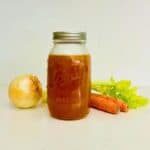
Brown Chicken Stock
Do you want to make the best gravy of your life? Master this brown chicken stock recipe first! Your freezer full of bones is about to become your golden ticket.
Servings: 2 quarts
Calories: 200kcal
Equipment
- 2- 2 gallon stock pots
- 1- 18 by 13-inch cookie sheet
- scale
- butcher string (optional)
- fine mesh strainer
Ingredients
- 3½ pounds chicken and turkey bones
- 14 ounces onions, peeled about 2-3 medium-sized
- 7 ounces celery about 4 medium stalks
- 7 ounces carrot, peeled and trimmed about 3-4 medium
- 1 ounce fresh Italian parsley with stems
- ½ ounce fresh thyme with stems
- 4 bay leaves
- 1 tablespoon black peppercorns
- 6 cloves garlic, peeled
- ¼ cup tomato paste
- 10 cups cold water
Instructions
- Preheat oven to 400℉.
- Spread out the frozen or fresh poultry bones on a cookie sheet.
- Cook 30 minutes in the oven until they start to develop color.
- While the bones are roasting, peel and trim the onions, carrots, and celery into 2-inch chunks. Don't use the yellow inside of the celery because it is bitter.
- After 30 minutes of roasting the bones, stir the bones with tongs. Then, add the onions, carrots, and celery to the bones on the same cookie sheet. Roast for about 45-60 minutes longer. Make sure the bones are very brown before removing them from the oven.
- Transfer the bones and roasted vegetables to a 2-gallon stock pot. Add a cup of warm tap water to the cookie sheet. If the bits are black and charred, skip scraping them into the stock pot as they will create a bitter finish. Otherwise, scrape the brown bits from the cookie sheet with a wooden spoon to loosen them. Add this water to the pot of bones.
- Use butcher string to tie the fresh herbs together in a bundle. This optional step helps make it easier to skim later.
- Add the water, herbs, garlic cloves, and tomato paste to the pot. Turn the burner to medium-high and start to bring to a gentle boil, then turn the burner down to maintain a strong simmer for 4-5 hours while skimming the foam and solids from the top every 15 minutes for the first hour. Don't let it boil vigorously because it can make your stock cloudy. Reduce the stock by 25%.
- Turn off the burner. With a fine mesh strainer over a second stock pot, use tongs to transfer the bones and vegetables to the strainer. Allow them to drain naturally rather than pushing down on them to prevent clouding your stock. The bones and vegetables are exhausted and can be disposed of. Continue this process until most of the large parts are removed. Then, pour the remaining stock through the strainer. If you are using the stock the same day, keep it over a simmer until ready to use.
- To refrigerate, cool to room temperature by placing the pot in an ice bath in the sink or with cold water around the pot, refresh the water twice if you don't have ice. Once cooled to room temperature, finish chilling the uncovered stock in the refrigerator overnight. Skim the fat off the chilled stock. Store in the fridge for up to 3 days.
- To freeze, scoop chilled portions into freezer zip-lock bags and remove as much air as possible. I like to portion 1 cup for sauces and 1 quart for gravy and soups. Label the bags with the description, quantity, date, and freeze for up to 6 months. Lay the bags on a small cookie sheet until frozen because they are easier to store.
Video
Notes
To double the recipe, you will need 2 cookie sheets for roasting and a larger, 2.5-gallon stock pot for simmering.
Nutrition
Calories: 200kcal | Carbohydrates: 46g | Protein: 7g | Fat: 1g | Saturated Fat: 0.3g | Polyunsaturated Fat: 0.4g | Monounsaturated Fat: 0.2g | Sodium: 485mg | Potassium: 1423mg | Fiber: 12g | Sugar: 19g | Vitamin A: 19097IU | Vitamin C: 64mg | Calcium: 254mg | Iron: 5mg
